
A Brief Interlude on Technical News Most Profound
In the last post (A Symbolic Experiment – Part 7: Derivative Rewriting) it was promised (or was it teased) that the various pieces needed to implement a simple symbolic Fourier transform system would be the subject of the next post but important technical news intervened that was worth commenting on instead.
This isn’t the run-of-the-mill news about a new study showing a breakthrough advance in the sciences which turns out to be nothing of the kind. It was the kind of news that comes once in a generation and which, if properly understood and reflected upon, points out the unintended consequences that arise when we don’t think philosophically but rather scientifically. This once-in-a-generation news was not largely picked up by the standard media but it is important in both scope (its impact stretches worldwide) and in impact (it involves one of the most precious commodities we have).
What exactly is this deeply important but largely ignored news one might ask? Well, as hard as it is to imagine that it is true but the insanity of the leap second is finally over: It’s Official: Timekeepers Have Gotten Rid of the Leap Second—and Introduced the Leap Hour Instead. Now, to put things into perspective, as insanity goes, this was a minor one that can’t even begin to hold a candle to the larger insanities of our day (war, abortion, government corruption, human marginalization, etc.). But it is a poster child for what is wrong when scientific thinking become unmoored from conventional wisdom.
So before defending that last statement, let’s take a step back to talk about what a leap second is and why scientists felt the need for it. Common experience and sense shows us that time and motion are inseparable, and, in some sense, time is defined by motion.
In Chapter 1 of their book Gravitation, Misner, Thorne, and Wheeler cover some familiar time systems and the moving clocks that realized the second. For example, prior to 1956 the second was defined as 1/86,400 of a mean solar day. The mean solar day is defined as the average time for subsequent passages of the Sun through zenith. Taking the average of numerous passages removes the unwanted motion associated with the fact that the Earth doesn’t move uniformly about neither its spin axis nor about the Sun (more precisely about the solar system barycenter – a detail totally irrelevant to essentials of this argument). From 1956 to 1967, the second was ‘redefined’ (more accurately re-realized) in terms of a broader sweep of motion as a 1/31,556,925.9747 of a reference tropical year. With the advent of the atomic clock as a timekeeping device (as opposed to a laboratory gadget) the second was redefined as a fixed number of oscillations between two reference quantum states in the Cesium 133 atom.
Once the atomic clock was available as a dedicated, practical timekeeping device, the deviations of the Earth’s orientation with respect to the fixed stars (as a proxy for an inertial coordinate system – another philosophical concept for another post) became easily apparent. The general gist of the deviation is that if we select a reference line of longitude (say the line upon which Greenwich, England sits) we can set noon on some given day as the moment that the Sun is at is zenith (motion again). If the motion of the Sun and Earth were uniform then exactly 86,400 seconds later the Sun would again pass through zenith just as that reference longitude were underneath. Any deviations aren’t noticeable if the second is defined in terms of the motion itself but become painfully obvious when the independent measure of time that is the atomic clock becomes available.
I think that it was this very precise definition in terms of the atomic clock and the heady challenge that quantum mechanics presented to conventional thinking of the day that probably swayed the scientific community of its day to introduce the leap second.
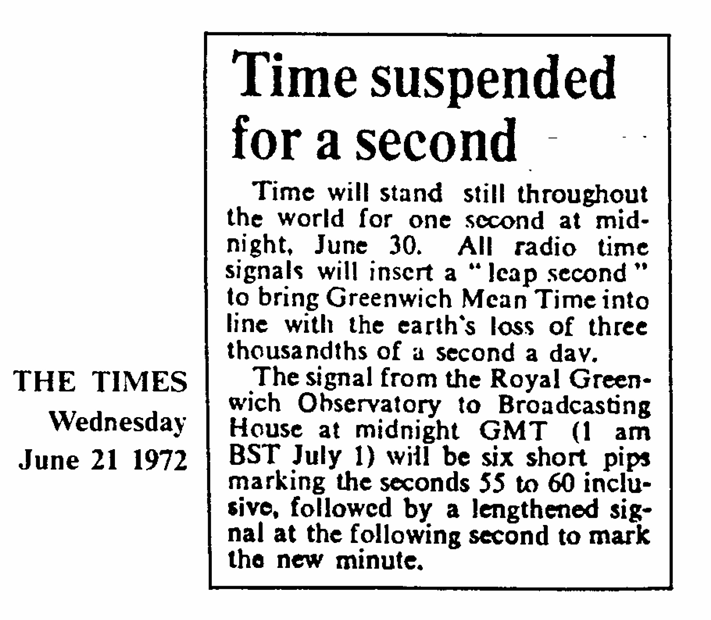
This image, taken from Chapter 1 of Gravitation, shows just how proud everyone was when the first set of 12 leap seconds were introduced in 1972. The article also shows just how ignorant the media of the day was (so unlike the modern media) as time wasn’t standing still but rather we were ‘double labeling’ successive seconds. This double labeling meant that each day with a leap second had 86,401 seconds with the time stamp 23:59:59 being followed by 23:59:60 as a separate label distinct from 00:00:00 on the next day.
Of the subsequent 50 or so years, an additional 27 seconds were included at various times to keep solar zenith on the reference longitude within one second of noon. The elapsed time between applications of the leap second were not uniform or regular. Scientifically, all seemed to go well: worldwide observations measure the deviation, a group of eminent thinkers analyze and decide, and the rest of us put the leap second into action. But it is on that last step that the gap between scientific and philosophical thinking emerges.
Most of the world doesn’t care nor does it even notice that the Sun isn’t at zenith exactly at noon. Of the entire population of the world, it can be said, with both philosophical and scientific certainty, that the number of people who live on a reference longitude in their particular time zone is a set of zero measure. Nearly almost everyone lives on one side or the other of this magic reference found somewhere within the time zone in which they live. So, the leap second as a astronomical event is ignorable. But the issues with time keeping (see the earlier post Representing Time) are significantly difficult even when there is a standard of 86,400 seconds in a day. These problems get magnified substantially when some removed intellectuals episodically decided to include a ‘special extra second’ every once in while. Most computer systems, operating systems, and languages don’t even have a mechanism for tracking the leap second resulting in various boutique implementations in wider or narrower use worldwide. Implementation of the leap second cost countless millions of dollars every time it was applied – resources that could’ve have been better used somewhere else.
I think that the lesson that comes from the half century of the leap second can be summarized in one old aphorism: just because we can do a thing doesn’t mean we should do it. Maybe this wisdom will finally take root in the scientific community but I doubt it.